Hey guys, let’s cut to the chase. If you’re in the market for wall coverings right now—whether you’re a homeowner refreshing a living room, a contractor finishing up a commercial space, or maybe a designer hunting for that “wow” factor that’s been missing—you’ve probably stared at two big options: plain old traditional stuff (think paint, wallpaper, tile) and those 3D wall panels I sell as a supplier. I get it, when I first started with these things, I was like, “3D panels? Aren’t those just a fancy trend?” Turns out, after years of seeing them go in everywhere from tiny rental apartments to big office lobbies, there’s actually a real, measurable difference between the two. No fluff, let’s break this down. 3D Wall Panel

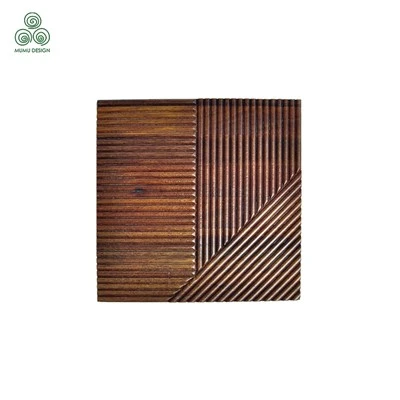
First off, let’s stop vague-ing this up—traditional wall coverings, for anyone who’s slept under a rock, are basically the classics you’ve known forever. Paint is the biggest one, obviously—you roll it on, pick a color, done. Wallpaper’s next, that paper or vinyl stuff that you paste to the wall, pattern included. Tile? Ceramic, stone, whatever, usually for bathrooms and kitchens. Then there’s wood paneling, fabric coverings, all that. Traditional stuff works, no cap, it’s been around for decades for a reason. But 3D wall panels? These are the ones I sell—they’re made from all kinds of materials: PVC, MDF, recycled wood fiber, even eco-friendly plaster, and they have that raised, textured design. Think grooves, waves, geometric shapes, even subtle floral imprints. They’re not flat, that’s the key.
Let’s start with installation, because that’s the first thing anyone cares about, right? I’ve seen so many horror stories with wallpaper—getting bubbles under it, cutting it wrong around outlets, peeling at the edges in humid places like bathrooms. Paint? It’s messy if you’re not good with a roller, takes forever to dry, and you have to do multiple coats. Tile? Don’t even get me started—measuring every tile, spacing them, grouting, that whole process takes hours, days even, depending on the size of the space. Now 3D panels? Yeah, they take a little prep, but once you get the hang of it, it’s way faster. Most of our panels are interlocking, like puzzle pieces. You just measure the wall, line up the first one, nail it or glue it on, and the next one snaps right into the edge of the last. No weird measuring gaps because the edges are designed to lock. I recently had a client who owned a small café—he put up 200 square feet of our wood-fiber 3D panels in his seating area in half a day. The same job would’ve taken him two days to wallpaper and another day to fix the bubbles. That’s a huge win for anyone on a tight timeline, or who’s a DIYer (no, I’m not a handyman, but even I could get the basics down with a little YouTube tutorial).
Next up, durability. This is where 3D panels actually shine. Let’s compare paint first: scuff a wall with a chair leg, and you’ve got a mark that’s almost impossible to get rid of without repainting the whole spot. Wallpaper? It tears if you hang something heavy on it, and if a kid crayons it, you’re stuck replacing a whole section. Tile? It’s pretty tough, but if a tile cracks, replacing it is a pain because you have to match the exact color and pattern, and grout it in. Now our 3D panels? Depending on the material, they’re way more resistant to scratches, scuffs, and even minor impacts. The PVC ones we make for commercial spaces are water-resistant, so if someone spills coffee or a soda, you can just wipe it right off—no staining. The MDF ones? We seal them with a clear coat, so they hold up in bedrooms and living rooms too, no dents from moving furniture. I had a school client last year who installed our 3D panels in their hallway—those hallways get slammed into by backpacks every single day. A year later, not a single scratch mark, while the adjacent traditional painted walls were already chipped and scuffed in multiple spots. That’s a big deal for high-traffic areas, no question.
Then there’s design, because let’s be real—looks matter. Traditional stuff is great, but it’s so limited when it comes to adding depth. Paint is flat—you get color, that’s it, unless you do some fancy accent wall with stencils, but that’s time-consuming and easy to mess up. Wallpaper has patterns, but they’re flat, right? The texture is just a slight print, not something you can actually feel. Tile? It’s hard, can have texture, but it’s usually the same across the whole piece, so it doesn’t add that dynamic look. 3D panels? You can go so many places with design. We have panels that look like stacked stone, for a rustic living room. We have sleek, geometric ones with sharp lines for modern offices. We even have fabric-backed 3D panels that add a soft, cozy vibe to bedrooms, like a headboard wall. The best part? They add dimension to a room without you having to build a whole accent wall with wood or other materials. A lot of our residential clients tell us that their friends come over and think they spent thousands on a custom built-in, when really it was just a few hundred square feet of our panels. And if you get bored of the look? You can even paint most of our panels. Wait, let’s test that—paint a flat wall, it’s easy but if it chips, bad. Paint a 3D panel, the texture of the panel actually makes the paint look way more interesting. It’s like a whole new look without redoing the entire wall.
Now, let’s talk costs, because money is always a factor. I know a lot of people hear “3D wall panels” and think they’re way more expensive than traditional stuff, but let’s do the math here. Let’s take a 100 square foot wall, that’s a common size for an accent wall. Paint: let’s say a high-quality interior paint is $30 a gallon, and you need two gallons for two coats, plus a roller, tape, tray—total is like $70. Wallpaper: a roll of good wallpaper covers about 25 square feet, so you need 4 rolls, that’s $40-$80 a roll, so $160-$320. Tile: ceramic tile is $10-$20 a square foot, plus grout, spacers, thinset, that’s $1000-$2000. Now 3D panels: our average price is $10-$25 a square foot, so for 100 square feet, that’s $1000-$2500. Wait, hold on, that’s more than paint or some wallpaper, but wait—what about installation? If you hire a professional painter, that’s $50-$100 an hour, so a 100 square foot wall is like 4 hours, $200-$400. Wallpaper installer? Even more, like $100-$150 an hour, so $400-$600. Tile installer? That’s $15-$20 a square foot, so $1500-$2000 for installation. Now 3D panels installation? We’ve had guys do it for $3-$5 a square foot, so $300-$500 total for installation. Oh, and wait—durability! We already talked about how 3D panels last way longer. Paint might need a touch-up in a year, a full repaint in 3 years. Wallpaper might start peeling in 5 years. Our panels? They last 10+ years, easy, without major repairs. So over time, that $2000 3D panel wall is cheaper than redoing paint every 3 years, right? And if you compare to high-end wallpaper or custom tile, 3D panels are actually cheaper long-term, and way easier to install. I’ve had a lot of small business owners go with our panels instead of tile for their bathrooms and kitchens, because it’s half the cost and way faster to put in.
Wait, I can’t skip sustainability, because everyone’s asking about that lately. Traditional wall coverings have their issues. Paint has volatile organic compounds (VOCs) that release fumes, especially cheap paint. Wallpaper is often made with vinyl, which is plastic, hard to recycle. Tile is heavy, hard to dispose of, and a lot of it is made from non-renewable stone or clay. What about 3D panels? We make a lot of our panels from recycled materials—recycled wood fiber, recycled PVC from old pipes, even recycled plastic bottles. Our eco-friendly line is made from biodegradable plaster, no VOCs, no fumes, so it’s safe for kids and pets. And when you’re done with the panels (which is like 10+ years), most of them are recyclable, or if you can’t, they break down way easier than vinyl wallpaper or ceramic tile. I had a client who’s a sustainability consultant install our recycled wood panels in her office—she told me she’d been trying to find low-waste wall coverings for years, and our panels were the first thing that actually worked. That’s a big one for people who care about their carbon footprint.
But wait, I’m not gonna lie, there are downsides to 3D panels, so you don’t get the wrong idea. First, they’re not for every space. If you have super uneven walls, you have to prep them way more than you would for paint. With paint, you can sand a little bump and it’s fine, with panels, you have to make the wall as flat as possible, because if there’s a gap behind a panel, it’ll look lumpy. Also, if you’re a total beginner DIYer who’s never hung anything heavier than a picture frame, maybe stick to paint first—installation is simpler than tile or wallpaper, but it’s not just slapping it on, you have to make sure it’s level. And another thing: they collect dust a little more than flat wall coverings. The texture holds onto dust, so you have to wipe them down every few weeks with a soft cloth, instead of just wiping a flat wall once a month. That’s a small thing, but worth mentioning, because I know a lot of people hate cleaning extra.
Now, let’s get real, who should pick which? If you’re on a super tight budget for a temporary space, like a rental that you’re moving out of in a year, paint is probably the way to go—cheaper, easier to cover up when you leave. If you want a quick, easy refresh for a bedroom accent wall, and you like texture, 3D panels are perfect. If you have a high-traffic space, like a café, office hallway, or a kid’s playroom, 3D panels win hands down for durability. If you’re doing a full bathroom or kitchen backsplash, tile is still great for water resistance, but our waterproof PVC panels are a way easier, cheaper alternative.
At the end of the day, the choice comes down to what you care about most: speed, durability, design, budget, sustainability. I’ve seen people swear by traditional stuff, and I’ve seen people obsessed with 3D panels, and neither is wrong. But from my years as a 3D wall panel supplier, I can tell you that 3D panels aren’t just a trendy gimmick—they solve a lot of the pain points of traditional wall coverings, while adding stuff that flat walls can’t.
If you’re curious to see how they look in person, or you’re ready to get a quote for your next project, reach out anytime. We can send samples, walk through your space, and figure out what works for you, no pressure.
Wooden Cabinets References:
- National Association of Home Builders. (2022). "Durability and Maintenance of Interior Wall Finishes." NAHB Research Center.
- Environmental Protection Agency. (2021). "VOC Emissions from Common Building Materials and Finishes." EPA Indoor Air Quality Program.
- Tile Council of North America. (2023). "Cost and Installation Time Comparison of Residential Wall Coverings." TCNA Industry Reports.
- Sustainable Furnishings Council. (2022). "Eco-Friendly Wall Finishes: Options and Performance." SFC Product Guides.
Dongguan MUMU Woodwork Co., Ltd.
Dongguan MUMU Woodwork Co., Ltd. is one of the most professional 3d wall panel manufacturers and suppliers in China, featured by cheap products and good service. If you’re going to wholesale customized 3d wall panel at low price, welcome to get quotation and free sample from our factory. Contact us for more discount information.
Address: Room No.2602, Universal Commerce Center,Dongguan, China 523073
E-mail: Jerry@mumu-ing.com
WebSite: https://www.mumu-ing.com/
